
We’ve all felt that sinking feeling in the pit of our stomachs this week. A few days ago, on March 9, 2026, as the Sensex flashed red with a 1,353-point drop, it wasn’t just numbers on a screen, it was our hard-earned savings taking a hit. Brent crude oil surged to $119 per barrel, natural gas prices also spiked sharply amid supply concerns, and the rupee hit a record low against the dollar. Portfolios across the country turned deep red.
The reason? Escalating tensions between the United States, Israel, and Iran. The conflict entered its fifth day on March 4, and markets have been bleeding ever since. The Strait of Hormuz, through which 40% of India’s oil imports pass, saw tanker traffic drop by 70%. At one point, traffic went to zero.
Every headline is predicting disaster. Analysts are warning about prolonged conflict. Conversations everywhere revolve around pulling out investments. Every instinct screams the same message: sell now, save what remains.
This reaction, while understandable, represents exactly the wrong move. It’s hard to ignore the “noise” when your phone is buzzing every ten minutes with a new notification about war. We are wired to survive, and right now, survival feels like hitting the “Sell” button.
When crude oil trades at $119, when geopolitical tensions explode, and when hard-earned money shrinks daily, the advice to invest more seems reckless. Yet history proves an uncomfortable truth. The best time to invest arrives precisely when fear peaks. Legendary investor Warren Buffett famously captured this behavior when he said:
“Be fearful when others are greedy and greedy when others are fearful.”
Understanding the Current Crisis
The present market correction is real. The geopolitical tensions are genuine, and their potential economic impact cannot be dismissed. India imports around 85–90% of its crude oil requirements, which makes the economy particularly sensitive to global oil price movements. Beyond oil, India is also a significant importer of natural gas, which is critical for power generation, city gas distribution, and industrial processes. Adding to this vulnerability, India depends heavily on imports of key raw materials for fertiliser production such as ammonia, phosphoric acid, and potash. A disruption in the supply chain of these materials can drive up agricultural input costs, pushing inflation further across the food supply chain. When oil and gas prices spike together, the effects ripple across multiple sectors of the economy.
Higher crude and gas prices can lead to:
- Rising inflation
- A weaker rupee
- Higher import bills
- Pressure on corporate profit margins
- Increased costs of agricultural inputs, affecting food prices and rural incomes
These concerns are valid and cannot be ignored. However, what often gets lost in moments of panic is perspective. Financial markets have endured far more severe crises in the past, and each time they eventually recovered.
Three Crashes, Three Recoveries: The Pattern That Repeats
Let’s look at three major market crashes over the past 17 years. Each felt unique at the time and created genuine fear. However, each of them was followed by complete recovery.
The 2008 Global Financial Crisis
The 2008 global financial crisis remains one of the most dramatic market collapses in modern financial history. During this period, the Sensex plunged from nearly 21,000 points to around 8,000 points. Major global banks collapsed, and the investment bank Lehman Brothers filed for bankruptcy, triggering widespread panic across the global financial system.
At that time, the dominant narrative suggested that the entire financial system might collapse. Governments across the world were forced to intervene with massive bailout packages. Unemployment rose sharply, businesses shut down, and investor confidence evaporated. This was not an exaggerated panic; it was a genuine global crisis.
However, the long-term outcome told a different story. Investors who purchased strong companies during this period saw their investments grow by more than 250% by 2014 as markets gradually recovered. The crisis was real, but so was the recovery that followed.
The COVID Crash: March 2020
The pandemic triggered one of the fastest market crashes in modern history.
Within a matter of weeks, the Nifty plummeted from 12,000 to 7,500, representing a drop of approximately 38–39%. Entire economies shut down almost overnight. Millions of people lost their jobs, and global supply chains collapsed. Many experts predicted that economic recovery could take several years, if not a decade.
Yet the market response was surprisingly swift. By November 2020, the Nifty had already recovered to the 12,000 level, completing a full rebound within just seven months. By 2021, investors who held their positions saw 100% returns.
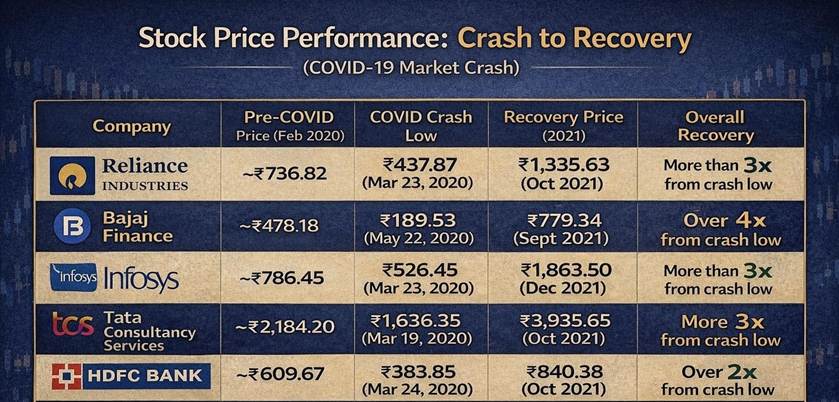
Image Source: Data from NSE India, BSE India, Yahoo Finance historical data (2020–2021). Visualization by Bars Wealth Management.
Key Insight: Investors who bought quality companies near the March 2020 crash lows saw returns ranging from 100% to over 300% within the next 18–24 months.
The 2024-2025 Correction
Fast forward to recent times. The Sensex reached an all-time high of 85,978 in September 2024. Then the correction began. By February 2025, the index had dropped over 10,000 points. Foreign investors pulled out billions of dollars from Indian equities over several months, driven by a combination of factors including a strengthening US dollar, rising US bond yields that made American markets comparatively more attractive, concerns over slowing earnings growth in India’s IT and banking sectors, and uncertainty triggered by Donald Trump’s tariff announcements, which weighed on global emerging market sentiment. As a significant trade partner of the US, India was not immune to the ripple effects of these developments. The India VIX, measuring market fear, jumped 59% in a single session.
The panic looked familiar but in early March 2025, before the current geopolitical crisis, markets staged a sharp recovery. Investors who kept cash ready for opportunities made strong gains within weeks. Most participants missed this; they had sold in February, locking in losses.
The pattern clearly shows that every 4-6 years, a major crisis emerges and each time, it feels unique. However, recovery does follow because when markets fall due to fear or uncertainty instead of business deterioration, the fundamentals of good businesses remain intact. Companies such as Reliance, HDFC Bank, TCS, and Infosys continue producing goods, serving customers, and generating revenue. Their management teams and long-term earning potential largely remains untouched. In many cases, the only thing that changes during a crash is the stock price, not the strength of the business. That difference is what creates opportunity.
Bonus Insight
Apart from the events discussed above, history consistently shows the same pattern—markets fall during uncertainty but recover over time. The table below captures this resilience across decades of geopolitical events.
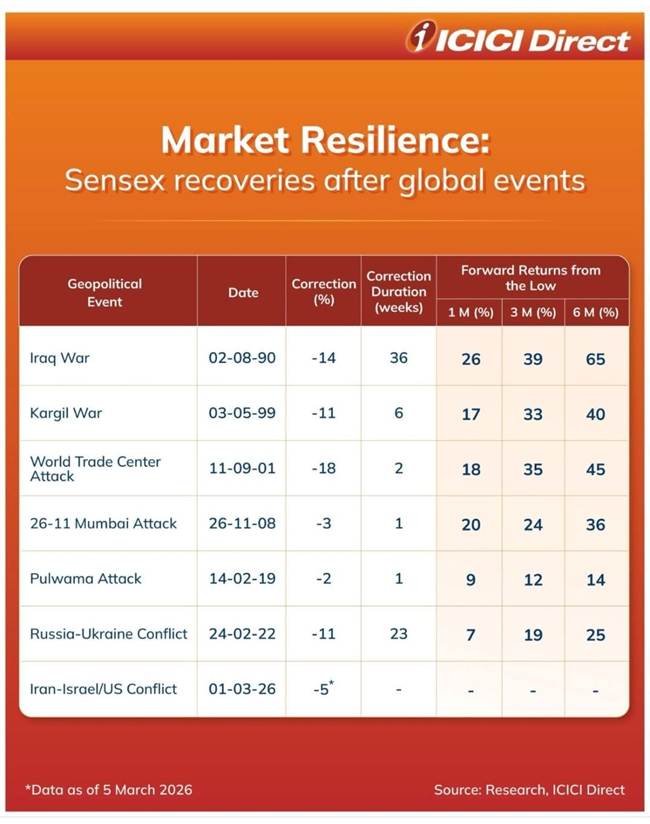
Image Source: ICICI Direct Research (as of March 2026)
The Mathematics of Buying During Crashes
The concept is straightforward. Suppose, an investor had been watching Infosys stock trading at ₹1,500. The company looked solid, but the price felt high.
During this crash, Infosys dropped to ₹1,200. The same company, with the same workforce, the same clients, the same capabilities, trading at a 20% discount.
In any other context, this would be recognized as a bargain. When a preferred brand offers 20% off, purchases increase. When property prices in a good location drop 20%, buyers emerge. Yet when stocks go on sale, the typical reaction involves fleeing. This disconnect stems from psychology, not logic.
Understanding the Psychological Battle
Market crashes trigger powerful emotional responses in investors. When markets fall sharply, the brain tends to activate a survival-oriented response that prioritises immediate safety over long-term opportunity.
Three psychological forces often dominate decision-making during these periods:
Loss aversion
Psychological studies show that losing money feels significantly more painful than gaining money feels rewarding. As a result, investors often focus on stopping losses rather than identifying potential opportunities.
Recency bias
When markets fall for several days in a row, those recent losses begin to feel more important than years of historical growth. Short-term events start shaping long-term expectations.
Herd mentality
When everyone around us is selling and expressing fear, following the crowd feels safer. Unfortunately, the crowd often makes poor decisions during moments of extreme panic.
Understanding these forces does not eliminate fear. But it helps recognize that biology is driving decisions, not strategy.
How to Invest During a Crash
While the emotional difficulty of investing during a crash is real, certain strategies can help investors navigate these periods more effectively.
Create a written investment plan. Decide in advance how you will respond to market corrections. For example, you might commit to investing a fixed amount if the market falls below a certain level.
Use systematic investing. Instead of trying to perfectly time the market bottom, increase SIP contributions during corrections. For instance, if you normally invest ₹10,000 per month, you might temporarily increase it to ₹15,000 or ₹20,000 during downturns.
Maintain an emergency fund. Keeping at least six months of expenses in safe instruments such as fixed deposits or liquid funds ensures that you will not be forced to sell investments during difficult times.
Focus on quality businesses. Market crashes are not the ideal time for speculative investments. Instead, they provide opportunities to buy strong companies with solid balance sheets at more attractive valuations.
Know your risk profile. Before investing during a crash, assess how much volatility you can truly handle, both financially and emotionally. Overestimating your risk tolerance can lead to panic selling at the worst time. Staying within your comfort zone supports disciplined decision-making.
Align investments with your time horizon. If you need the money within the next 1–3 years, avoid increasing equity exposure during a crash. Markets can stay depressed for 12–24 months. Increase equity investments only if your time horizon is at least 5 years; otherwise, prefer safer instruments such as fixed deposits, short-duration debt funds, or liquid funds.
Control information intake. Stop checking portfolios hourly and avoid panic-inducing discussions. Media organisations design content to trigger fear because fear generates engagement.
When Not to Invest During Crashes
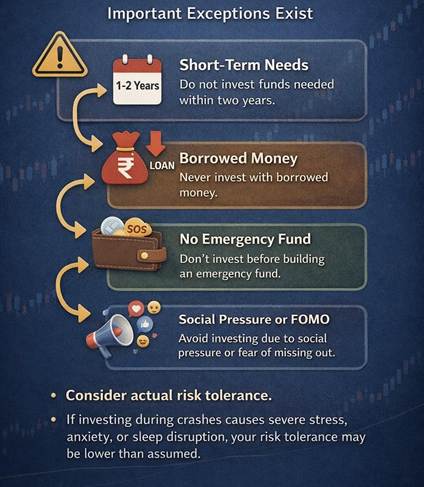
Image Source: Bars Wealth Management
The Timing Paradox
Most investors prefer to wait for certainty before investing. However, certainty typically appears when markets are already at their peak. When news is positive, optimism is high, and economic conditions appear stable, investors feel comfortable entering the market.
Unfortunately, those are often the moments when asset prices are already elevated. True bargains tend to appear during moments of discomfort for instance when oil prices surge, geopolitical tensions rise, and headlines predict economic disaster.
Discomfort, in many cases, becomes the price of opportunity.
What Comes Next
No one can predict exactly when the current market correction will end. Financial markets rarely move according to precise timelines, and geopolitical tensions, economic conditions, and investor sentiment can influence the pace of recovery. However, history consistently shows that markets eventually recover as economies continue to grow and businesses adapt to new realities.
At some point in the future, the turmoil that appears so significant today will likely look like just another temporary dip on a long-term market chart. This pattern has repeated itself through multiple crises, and it continues to remind investors of an important truth: the real question is not whether recovery will occur, but whether investors will be positioned to benefit when it does.
Market crashes test patience, conviction, and discipline. Watching portfolios decline creates uncertainty and challenges even experienced investors. The natural instinct during such periods is to step away from risk and wait for conditions to improve. Yet the irony of investing is that the moments when markets feel the most uncomfortable are often the same moments that create the most meaningful long-term opportunities.
These opportunities rarely come from speculation or short-term trading. They arise when strong businesses temporarily trade at discounted prices because fear dominates the market. When prices fall sharply due to panic rather than a fundamental deterioration in business performance, disciplined investors are able to accumulate quality assets at valuations that may not be available during normal market conditions.
Over time, stability tends to return. Oil prices stabilise, geopolitical tensions ease, corporate earnings recover, and economies continue expanding. As these forces gradually restore confidence, markets move forward again and new highs eventually follow.
When that happens, investors who remained patient and maintained discipline during periods of panic often look back at these moments with a different perspective. What once felt like uncertainty begins to appear as opportunity in hindsight.
Because in investing, fortunes are rarely built during moments of celebration and optimism. More often, they are built quietly during the crash.